Autonomous Waste Collection

Trash collection was built for routes.
We're building it for requests.

Robotrash deploys autonomous robot fleets to collect waste door-to-door (residents call when they're ready, not on a fixed schedule) and consolidate every pickup into a single operator container.

The system

Three components.
One autonomous loop.

The Robotrash platform connects a door-to-door robot fleet, a smart neighborhood station, and a real-time operator platform into one seamless collection system.

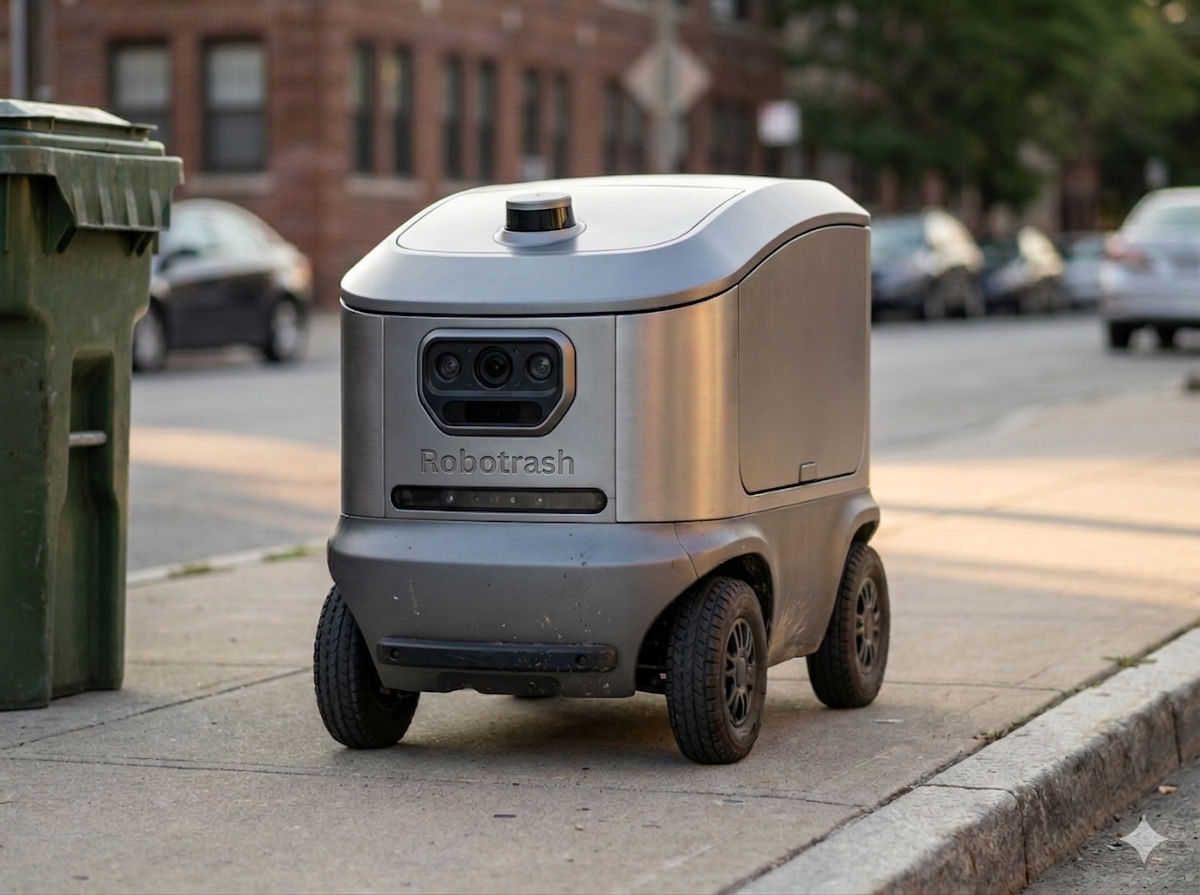
Robotrash autonomous collection robot on a sidewalk
Component 01
The Rover

Autonomous door-to-door collection robot. Navigates sidewalks and driveways using LiDAR and computer vision, accepts waste directly from residents, and routes itself to the zone station.

  • On-demand dispatch via resident app, <8 min ETA
  • LiDAR + camera navigation for pedestrian environments
  • Top-hatch waste acceptance at the resident's door
  • Auto-routes to zone station when capacity reached
Conceptual render: robot in development
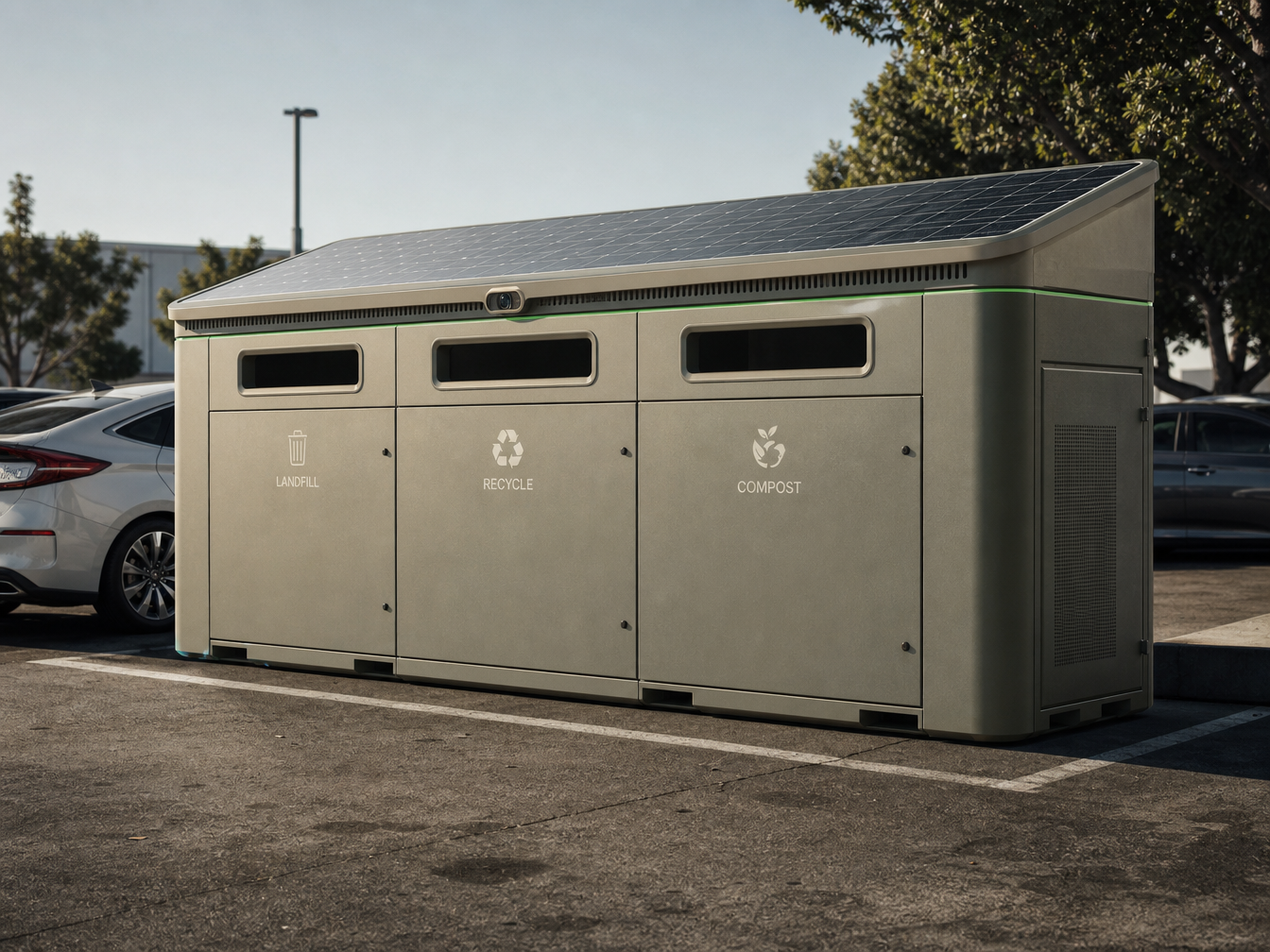
Robotrash zone station with solar panel, landfill, recycle, and compost compartments
Component 02
The Zone Station

Solar-powered neighborhood waste hub. Placed once per ~1,000-home zone, it consolidates every pickup from the robot fleet and signals the operator when it's ready for a single truck collection.

  • Solar-powered, no external power hookup required
  • Real-time fill sensor with automated operator alert at 80%
  • Robot docking port with auto-lock mechanism
  • Serves ~1,000 homes, one container per zone
Conceptual render: station in development
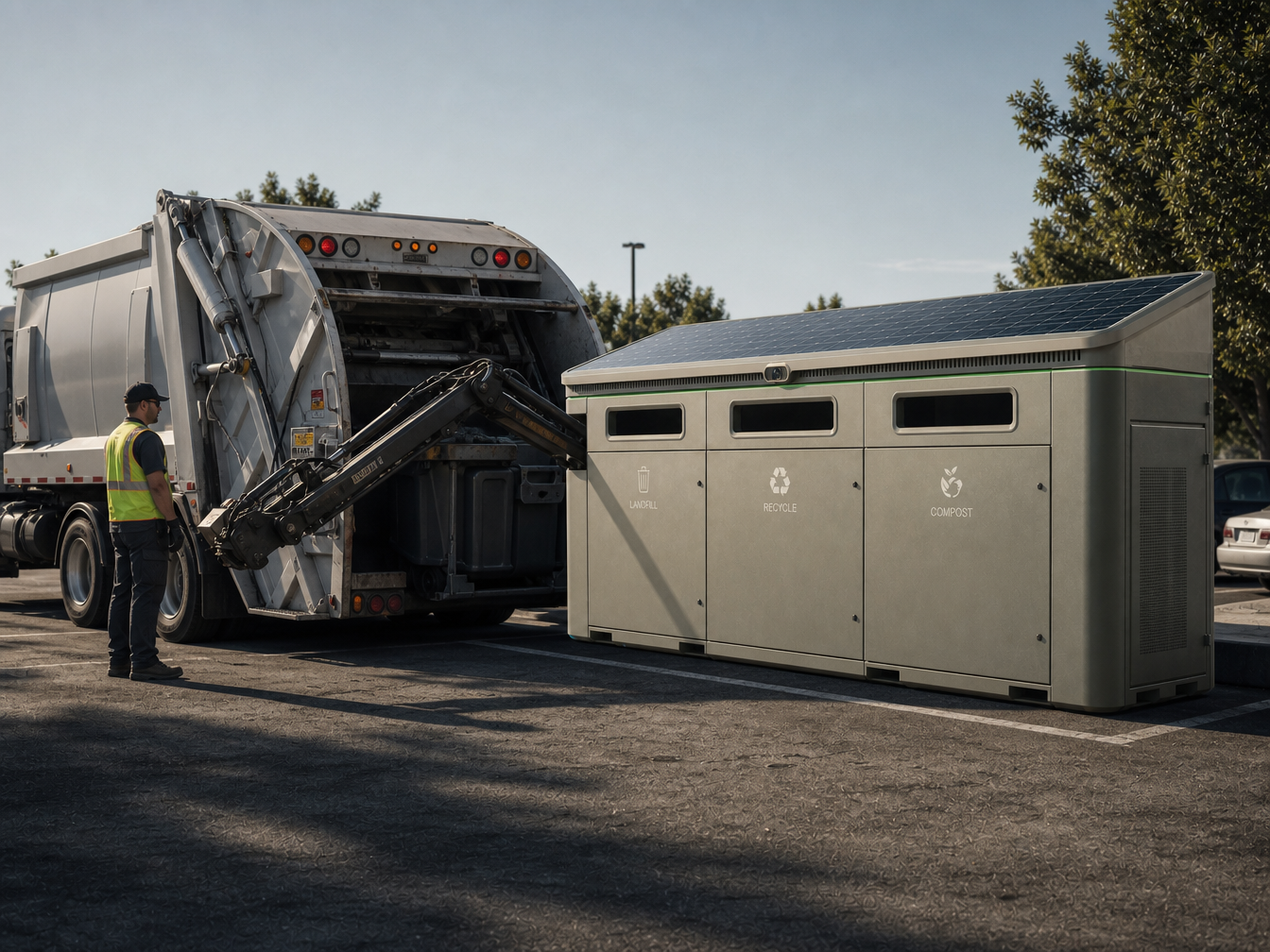
Operator truck picking up the Robotrash zone station container
Component 03
The Operator Pickup

When the zone station hits 80% capacity, the operator gets a single automated alert. One truck. One stop. The entire zone (landfill, recycling, and compost) emptied in a single visit.

  • Automated 80% fill alert triggers the operator pickup request
  • One truck services ~1,000 homes per visit
  • Separate compartments for landfill, recycling, and compost
  • No route planning: operators respond to demand, not schedules
Conceptual render: hardware in development
$70B
US municipal waste collection
market annually
600+
Individual stops per
residential truck route
34%
Rise in sanitation labor
costs since 2020 (BLS)
~1k
Homes served per
Robotrash zone container
The problem

Residential waste collection is the last major logistics category that hasn't been automated.

It costs $70B a year in the US alone. The labor is expensive and hard to retain. The routing is brutally inefficient. And the problem is getting structurally worse, not better.

34%

Labor crisis, no end in sight

Sanitation worker wages have risen 34% since 2020, faster than almost any other trade. Driver shortages in major metro areas are forcing overtime and route consolidation, pushing costs higher every year.

Bureau of Labor Statistics, 2024
$6–8

Cost per stop is unsustainably high

A standard residential collection truck makes 300–600 individual stops per route. Each stop costs operators an estimated $6–8 in labor and fuel. Across millions of routes, that's tens of billions in inefficiency annually.

SWANA 2023 benchmarking report
40%

Driver turnover makes routes unreliable

Sanitation driver turnover averages 40% annually in residential collection. When drivers quit, routes get combined, pickups get missed, and operators face municipal contract penalties. This isn't a hiring cycle. It's a structural workforce collapse.

SWANA Workforce Survey, 2023
The solution

On-demand collection. One container per zone. One operator pickup.

Robotrash solves the last mile (the most expensive, least efficient part of residential collection), replacing fixed-schedule truck routes with on-demand robot dispatch and a single consolidated operator pickup per zone.

Today
600

Stops per truck route

One diesel truck. One driver. Drive to every house, lift every bin, empty it, move on. Repeat 600 times every single day, for every street in every residential zone in America.

With Robotrash
1

Operator pickup per zone

The robot fleet services all 1,000 homes door-to-door, on demand. Every bag flows to a single neighborhood station. One operator truck. One pickup. The whole zone, done.

How it works

Five steps from door to done.

01
Request
Resident taps the app. Nearest robot dispatched in under 8 minutes.
02
Dispatch
Robot navigates sidewalks autonomously using LiDAR + computer vision.
03
Collection
Resident drops bags into the top hatch at the door. ~30 seconds.
04
Deposit
Robot routes to zone station, deposits waste, returns to dock.
05
Operator Pickup
At 80% fill, one alert fires. One truck. One stop. ~1,000 homes done.

Full step breakdown below ↓

01

Resident requests pickup

Tap the app. Nearest robot dispatched. ETA under 8 minutes. No schedule, no collection day: any time, any day.

02

Robot navigates to door

The rover uses LiDAR and vision to navigate sidewalks autonomously. Resident gets a push notification on arrival.

03

Resident loads waste

Bags drop directly into the hatch. No bin to drag to the curb. No schedule to remember. Takes about 30 seconds.

04

Robot deposits at station

The rover routes autonomously to the zone station, deposits the waste, and returns to its charging dock. No human in the loop.

05

Operator gets one request

At 80% fill the dashboard fires an automated pickup request. One truck. One stop. ~1,000 homes serviced.

The hardware stack

One System. Three Parts.

Robotrash is an integrated hardware and software stack, not just a robot.

ROBOTRASH 68 cm
THE ROBOT
Autonomous Collection Robot
  • LiDAR + computer vision navigation
  • Electric drivetrain, zero emissions
  • On-demand dispatch via resident app
  • Door-to-door waste acceptance hatch
Conceptual render: final design in development
FILL LEVEL 65% ~1,000 HOMES 1.4m
THE CONTAINER
Zone Container
  • Neighborhood-level consolidation point
  • Real-time fill-level sensors
  • Accommodates ~1,000 homes per zone
  • Single operator pickup point
Conceptual render: final design in development
OPERATOR DASHBOARD · LIVE ACTIVE 3 AT 80%+ 1 PICKUPS 4 FLEET 11/12 ZONE A 82% ZONE B 54% ZONE C 31% Zone A at 82%: pickup requested
THE DASHBOARD
Operator Dashboard
  • Live fill levels across all zones
  • Automated 80% threshold alerts
  • Fleet health monitoring
  • Compliance exports + API integration
Conceptual UI: platform in development
Zone Station Your home 4 MIN 2 MIN ARRIVING Robotrash Live Track your robot → Robot on the way Arrived! Open your door. Arriving in ~3 min · 143 Oak Lane
The resident experience

A product residents actually want to use.

The consumer app drives adoption inside a zone. High resident engagement means higher container fill rates, more predictable operator scheduling, and better unit economics for everyone.

It's also the network moat. Once residents are used to on-demand collection, a weekly truck feels like a downgrade. That stickiness is structural.

  • On-demand dispatch: residents call the robot when they have trash
  • Live robot tracking: watch it navigate to the door in real time
  • No bin trips: toss bags directly into the robot at the door
  • Pickup confirmation and full history for every collection
The vision

This is what we're
building toward.

Door-to-door autonomous collection: a robot navigates to a residential address, accepts waste directly from the resident, and transports it to a neighborhood container, no truck, no driver, no fixed schedule.

Illustrative footage: not Robotrash hardware. Robotrash robots are in development.

Building in motion

We're building before the
market knows it needs this.

We're at the build stage: technical architecture defined, operator outreach starting. What we have is a specific approach to a problem no existing robot has solved, and a clear path to first deployment.

Why now

LiDAR: $75,000 in 2017, under $500 in 2024. Sidewalk-capable electric drivetrains are now cost-competitive at sub-1-ton scale. Computer vision for pedestrian environments is solved at the foundation model level.

The hardware to build this finally costs less than a used car.

Three cost curves bottomed out at the same time. That's the opening.

What's broken

Trash systems don't talk to each other. Fill levels aren't tracked in real time. Routes run on fixed schedules regardless of demand. A residential waste route is 300–600 stops of the same mechanical sequence. That workflow hasn't changed since the 1960s.

The truck goes to the waste. The waste should come to a container.

Replacing the driver doesn't fix this. The architecture is wrong.

What we're building

The navigation stack is defined; we're building on proven sidewalk robotics. The active engineering challenge is the waste acceptance mechanism: the specific technical problem no delivery robot addresses today.

Zone coordination logic, routing multiple robots to a single container, is in early design. Every open problem is named. We know exactly where the risk is.

What we believe
  • 01
    The incumbents will not build this.Republic Services and Waste Management are optimized around the truck. Automating last-mile collection cannibalizes their largest workforce cost center before they have a replacement revenue model. They will buy this eventually; they won't build it.
  • 02
    The real buyer isn't the resident.It's the HOA property manager who writes one service contract and fields every missed-pickup complaint. Their incentive to switch is structural. They don't need to love the product; they need one fewer budget problem.
  • 03
    Zone container placement is the moat.Whoever places the first containers in a neighborhood controls the physical collection point. That infrastructure isn't software-switchable. First mover wins the zone for years.
What happens next
The sequence is
already running.
  • Mapping HOA contracts: now

    Reaching out to property managers in Aurora CO, Columbus OH, and Chandler AZ to understand contract structures and what a pilot actually requires.

  • First operator conversations

    Beginning outreach to operators before hardware is ready, to test assumptions, understand fill-level reporting constraints, and define pilot requirements.

  • Pilot target: late 2026

    Single HOA zone, ~500 homes. Prove robot reliability, measure container fill cadence, and test resident adoption without a marketing spend.

  • Three open hardware problems

    Hatch mechanism durability, container sensor reliability, navigation in edge-case weather. Known risks, being solved in order.

Why now

This window didn't exist
3 years ago. It closes soon.

Three structural shifts converged in 2023–2024. The company that captures this now becomes the infrastructure layer for residential waste collection.

+34%

Labor is becoming unaffordable

Sanitation wages up 34% since 2020 (BLS). Driver retention at historic lows. The economics of the status quo deteriorate every year.

−90%

Hardware costs collapsed

LiDAR dropped from $75,000 to under $500 per unit. Electric drivetrains now cost-competitive for sub-1-ton vehicles. The hardware to build this is finally affordable.

2035

Regulation is forcing the shift

The EPA's Clean Trucks Plan (Phase 3) sets strict zero-emission targets for vocational fleets through 2032, while state mandates require 75% of new garbage trucks to be zero-emission by 2035. Operators are already budgeting for the massive shift to fleet electrification.

Deployment strategy

Three markets.
One system.

Robotrash deploys the same platform across three expanding market segments, starting with HOA pilots and scaling to city-level infrastructure contracts.

Phase 01: 2026
HOA Communities

First paid pilots in master-planned suburban communities. HOAs negotiate one service contract, residents get on-demand collection, operators get a single consolidated pickup per zone.

~500homes per pilot zone
1operator pickup per week per zone
Aurora, CO Columbus, OH Chandler, AZ
65% Container fill · Zone A A B C
Phase 02: 2027
Waste Operators

Multi-zone operator contracts with regional and national waste collection companies. Robotrash becomes the last-mile platform layer on top of existing fleet operations, not a replacement.

10+zones per operator agreement
$70Btotal US market addressable
Republic Services Waste Management Regional operators
Active zone Expanding Planned
Phase 03: 2028+
City Infrastructure

Municipal-scale deployment across full metro areas. Robotrash becomes the last-mile infrastructure layer for residential waste, licensed to municipalities and operators as a utility-grade platform.

100+zones per city deployment
2035EPA zero-emission mandate deadline
Smart city contracts Municipal licensing
The market

The Market

Residential waste collection is a $70B industry running on 1960s infrastructure.

$70B
US residential waste collection market (annual)
Source: IBIS World, 2024
$21B
Estimated last-mile residential routing costs
Source: SWANA route cost benchmarking, 2023
300M+
US residential waste pickups per week
Source: EPA Municipal Solid Waste report, 2023
15%
Projected CAGR for autonomous waste tech (2024–2032)
Source: Allied Market Research, 2024
For operators & HOAs

Your last-mile problem,
finally solved.

Robotrash is built as an infrastructure layer: it slots into existing waste operations, replacing only the most expensive, least efficient part.

HOA & community deployment

One Robotrash zone serves ~1,000 homes with a single shared container. HOAs negotiate one service contract, no per-house routing, no collection-day coordination, no missed pickup complaints.

Solves last-mile for waste operators

Last-mile residential routing is the costliest part of every route. Robotrash consolidates ~1,000 homes into one container pickup: fewer routes, fewer drivers, dramatically lower cost per ton.

Zero-emission, zero noise

Electric robots mean no diesel on residential streets and no 5 a.m. truck noise. Residents notice immediately, and HOA boards care deeply about both.

Operator dashboard

Live container fill levels, fleet health, pickup logs, and compliance exports. One clean data feed per zone instead of route-level driver reports. Integrates with existing fleet management tools.

Operator Dashboard: Preview
Robotrash Operator Console Live in pilot
Active Zones
3
All online
Containers at 80%+
1
Zone A: pickup needed
Pickup Requests Today
4
3 completed · 1 queued
Robot Fleet
11/12
1 charging · all healthy
Zone Fill Levels
Zone A
82%
Zone B
54%
Zone C
31%
Fleet status: 11 active · 1 charging · 0 offline
The founder

One founder. Deep technical roots.
A very specific obsession.

Hardware infrastructure is a long game. Right now the focus is on technical architecture and early customer discovery, not scaling headcount before the model is proven.

BF

Babatunde Fashola

Founder & CEO

Software engineer. Built AI systems at IBM Watson Research Center, shipped consumer products at Twitter, and worked on financial infrastructure at Affirm. The gap between how waste collection works today and how it should work is too specific and too large to leave alone.

IBM Watson Twitter Affirm
For operators & HOAs

Run a pilot zone
in your community.

We're planning the first Robotrash pilot zones with select HOAs and municipal waste operators in Aurora CO, Columbus OH, and Chandler AZ.

Request a pilot →
For investors

Early build stage.
We're raising now.

Operator outreach underway. Raising our pre-seed to take the system from early prototype to first paid pilot. Deck sent within 24 hours.

Get the investor deck →